
Starting an Orange County Residents Directory Search
Begin with the fact already known. An exact street address belongs first in the Orange County Property Appraiser search. A full name may work better in the Comptroller's Official Records index or the Clerk's case search. A date or former address may point toward city directories, newspapers, cemetery material, or vital certificates. Each source records a different event, so no single result proves that a person now lives at a place.
The Orange County residents directory has gaps by design. Property files name titled owners, not all occupants. Voter files omit children, people who are not registered, and protected voters. Deeds identify parties to a recorded instrument. Historical books can miss a household between editions. Use a short, repeatable sequence:
- Search the Property Appraiser by owner name, address, parcel, sale, land use, or subdivision.
- Check the official Florida voter-status tool when you can supply the identity details it requests.
- Run the Comptroller's grantor and grantee index with spelling variants and a sensible date range.
- Use my eClerk for a party name tied to an Orange County court matter.
- Ask the right custodian for a nonexempt record that is not posted online.
The Offices Behind Orange County Resident Rolls
Orange County divides the useful rolls among independent constitutional offices. The Comptroller records deeds, mortgages, liens, plats, judgments, and related instruments. The Clerk of Courts keeps Circuit and County Court files, including probate, family, criminal, civil, and traffic cases. The Property Appraiser maintains parcel ownership, values, sales, maps, legal descriptions, and separate situs and mailing addresses. Elections records sit with the Supervisor of Elections. Picking the keeper first prevents a common mistake: asking the Clerk for a deed that belongs with the Comptroller.
Orange County Supervisor of Elections
Voter records and county election tools
Orlando, FL
For a street-wide question, the Orange County street directory method begins with address-keyed parcel and map tools before it branches into deeds or requested voter data.
Reading the Orange County Property Roll Correctly
OCPA is often the best first stop because its dashboard supports owner name, address, parcel, sales, land use, subdivision, and other modes. The parcel detail can connect a site to its titled owner, legal description, sale instruments, exemptions, values, and map. Yet the mailing address may differ from the situs address. The first is where the owner receives mail; the second is the parcel's physical location.
| Search route | Best clue | What it can add |
|---|---|---|
| Owner name | Person or entity name | Matching parcels and ownership |
| Address | Street number and name | Parcel facts and situs |
| Parcel | Parcel identifier | Exact tax-roll record |
| Sales | Date or transaction clue | Recorded sale references |
| Subdivision | Plat or neighborhood name | Related lots within the filing |
Open the OCPA property-search dashboard to see the available search modes. The dashboard image below shows why a parcel roll can orient a local resident search without serving as proof of occupancy.
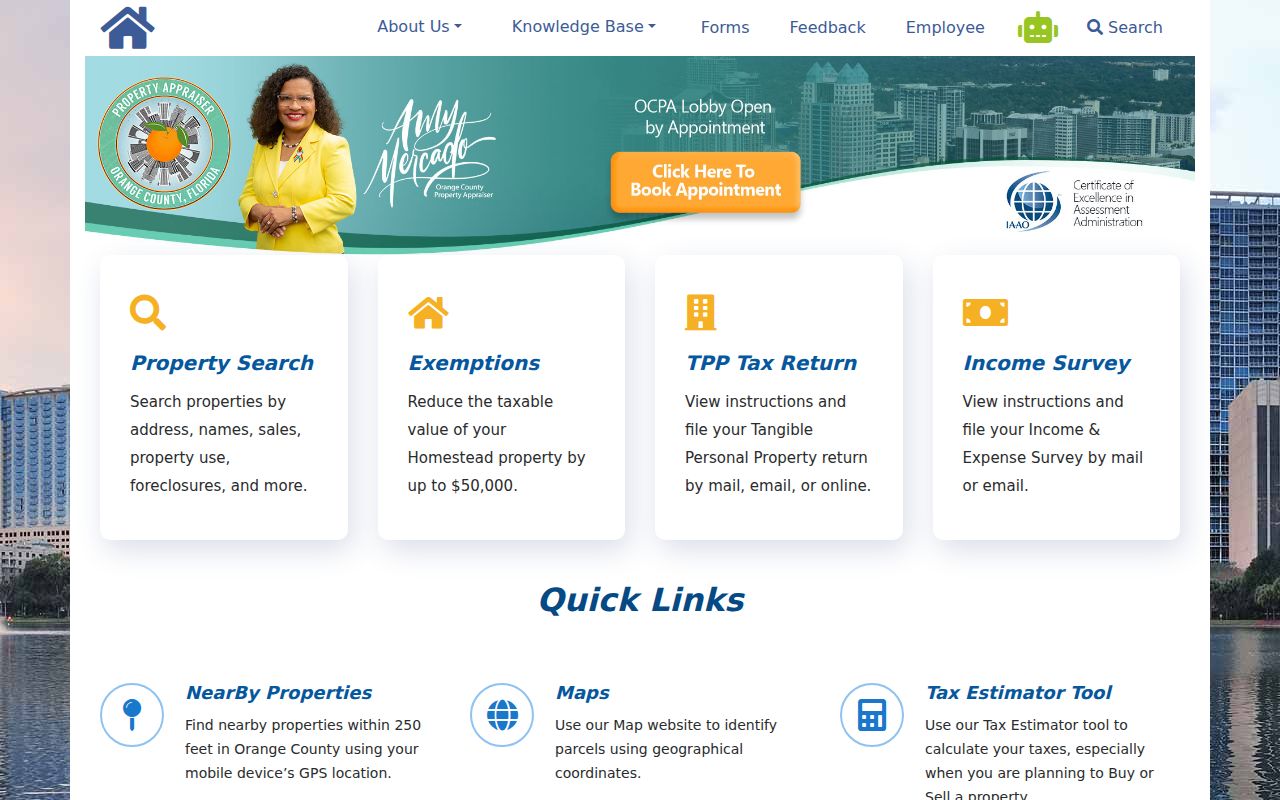
A parcel result is an anchor. Confirm a person through a deed, voter record, court index, directory entry, or other record tied to the question.
Orange County Official Records Start in 1878
The Comptroller's certified Official Records begin January 1, 1878. EagleRecorder searches an index by names, document types, recording dates, book and page, and other available criteria. It is a finding aid, not a promise that one spelling will reveal every filing. Try initials, prior names, and spelling variants. A deed, mortgage, lien, satisfaction, judgment, or plat can connect a person to a place or transaction, but the document date still does not prove present residence.
Visit the Orange County Official Records search before reviewing the captured portal view.
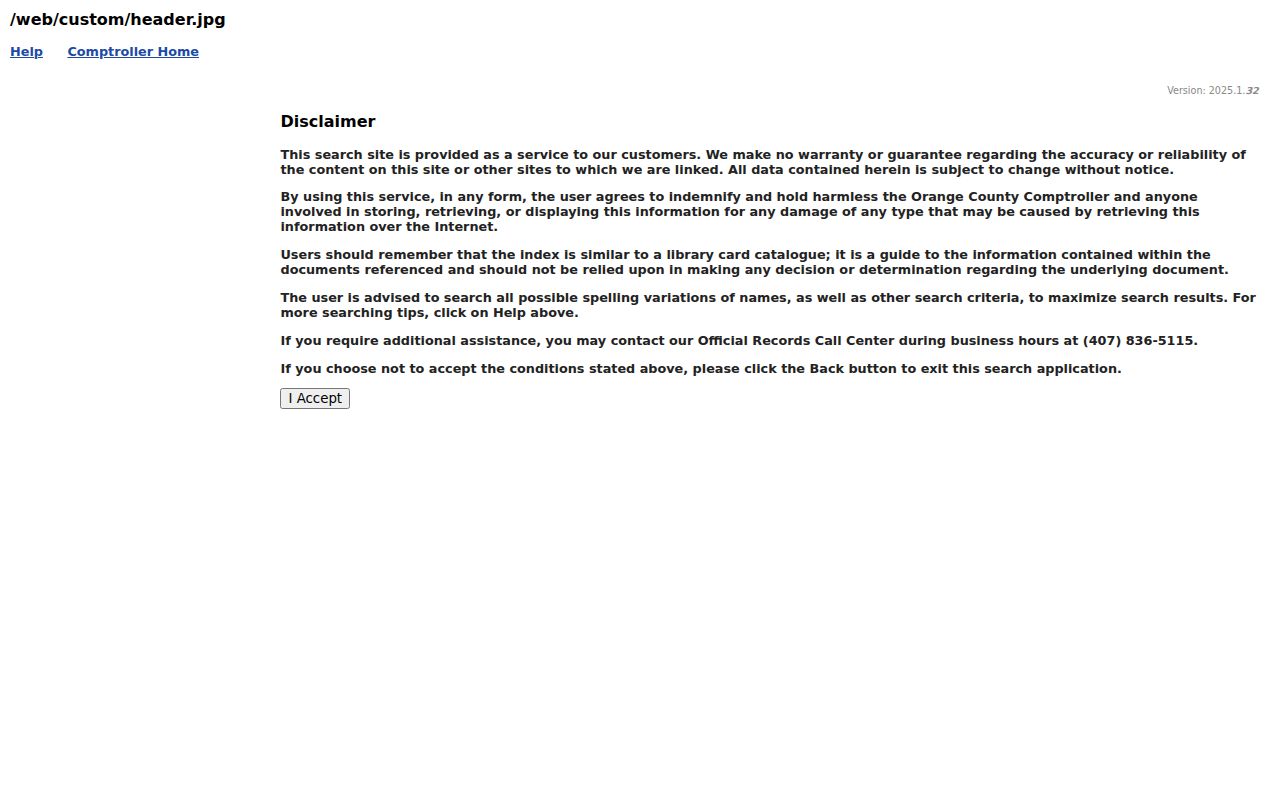
The index supplies the recording trail. Certified copies and questions about the official record go to the Comptroller, not to a private directory.
Present-Day Orange County Directory Sources
Current public sources describe different slices of the county. They should be compared, not merged into an imagined household list. Orange County resident rolls work best when the source matches the fact being checked and the user notes who is absent from that source.
| Public source | People or parties shown | Record keeper | Access path |
|---|---|---|---|
| Property roll | Titled owners and mailing contacts | Property Appraiser | Free public portal |
| Official Records | Parties to deeds, liens, mortgages, and judgments | Comptroller | Free index and available images |
| Court index | Named parties in eligible court cases | Clerk of Courts | my eClerk search |
| Voter records | Registered voters, subject to exemptions | Supervisor of Elections | Status tool or records request |
| Business filings | Officers, registered agents, and filing addresses | Florida Division of Corporations | Sunbiz index |
Property ownership is not occupancy. A court party name is not proof of identity. Voter data covers registered voters only. Those limits make cross-checking the core skill in any Orange County directory search.
What Florida Voter Records Reveal and Withhold
Florida Statutes section 97.0585 makes a voter's name, address, date of birth, party, phone, and email generally public. Social Security numbers, driver-license or state-ID numbers, and the application source are never public. A signature may be viewed but not copied. Protected voters are withheld. These rules matter because the public status tool is an identity-verification service, not a browseable roll of everyone on a street.
Use Florida's voter-status lookup for an individual verification. The captured form shows the controlled lookup route used by Orange County voters.
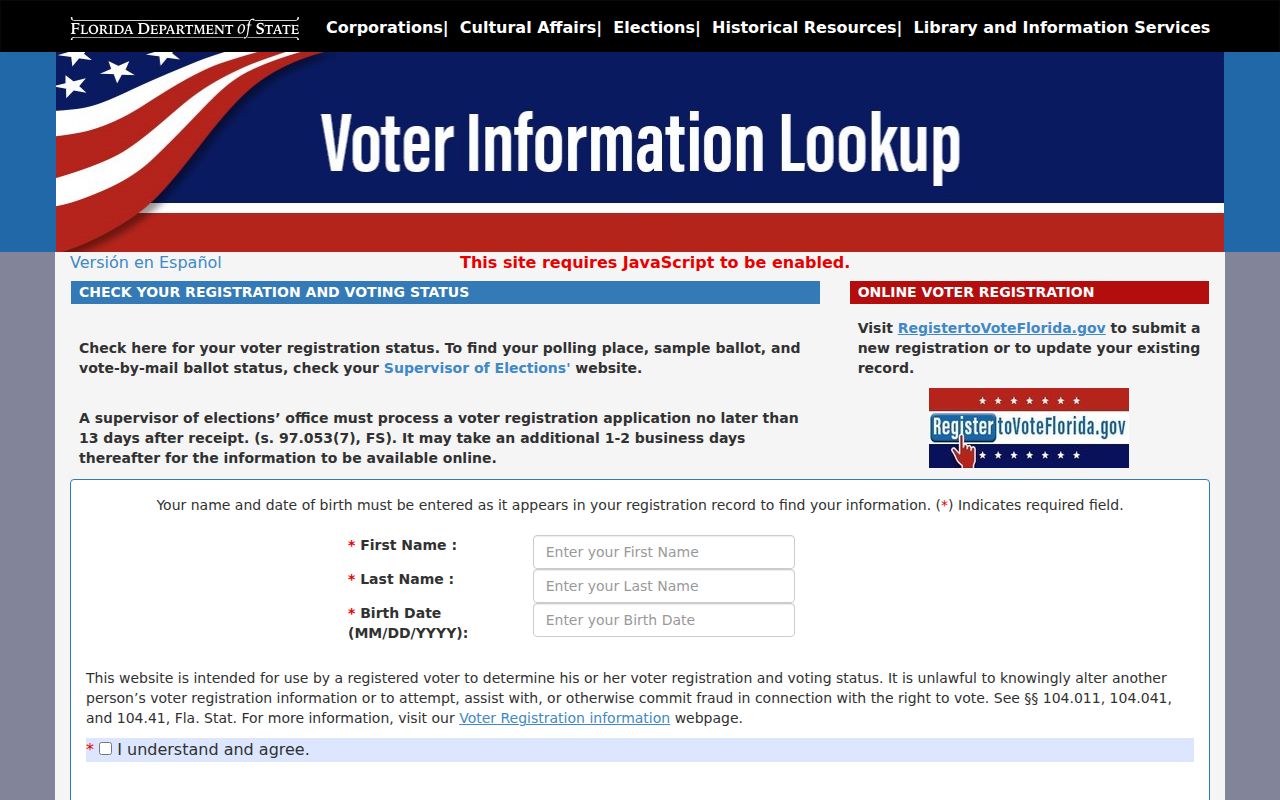
A geographic voter file or street index requires a request to the Supervisor of Elections. Specify a snapshot date, geography, active or inactive status, fields, and electronic format, then let the office omit protected data and quote any cost.
Orange County Court Names Need a Second Match
my eClerk provides docket data for most Orange County cases from about 1990, while online documents for most case types begin in 2009. Search options include party or business name, case number, citation, and date criteria. A docket is the court's event log. An index entry may identify a case, but it is not the same as the filed image or a certified copy. Older, restricted, or unavailable files may need a counter visit or records request.
Open the Orange County my eClerk case search to inspect the current fields.
Same-name residents are common. Match a middle name, address, filing date, case role, parcel, or another official index before treating the court result as the intended person.
Orange County Is Not One Permit Jurisdiction
A postal line that says Orlando does not prove that Orange County holds the permit. County Fast Track and Planning and Development records cover unincorporated Orange County. Incorporated addresses must go to the proper city, such as Orlando, Apopka, Maitland, Ocoee, Windermere, Oakland, Winter Garden, Winter Park, Bay Lake, Belle Isle, Edgewood, Eatonville, or Lake Buena Vista. The county public-records gateway routes users across many of these offices.
This boundary issue changes the search path. County Fast Track can expose permits, reviews, inspections, investigative reports, contractor licenses, and development records by address or parcel in its jurisdiction. A city address may instead call for that city's clerk, permit portal, police records unit, or archive. First verify the government boundary, then ask for the record.
Florida Public Records Requests Fill Online Gaps
Florida's Public Records Act, Chapter 119, and article I, section 24 of the Florida Constitution give any person access to nonexempt records. Florida residency and a reason for the request are ordinarily not required. The custodian must acknowledge the request promptly and respond in good faith, but there is no universal three-day or ten-day deadline. An office does not have to create a new record, answer questions, or reformat data that does not exist.
Write for an identifiable record. Name the office, date range, person or address, record type, and preferred electronic format. Ask for an estimate before extensive work. Ordinary copy ceilings are 15 cents for a one-sided page and 20 cents for a two-sided page, while a certified copy may cost up to $1 unless another law controls. Extensive staff or technology work may carry a reasonable actual-cost service charge.
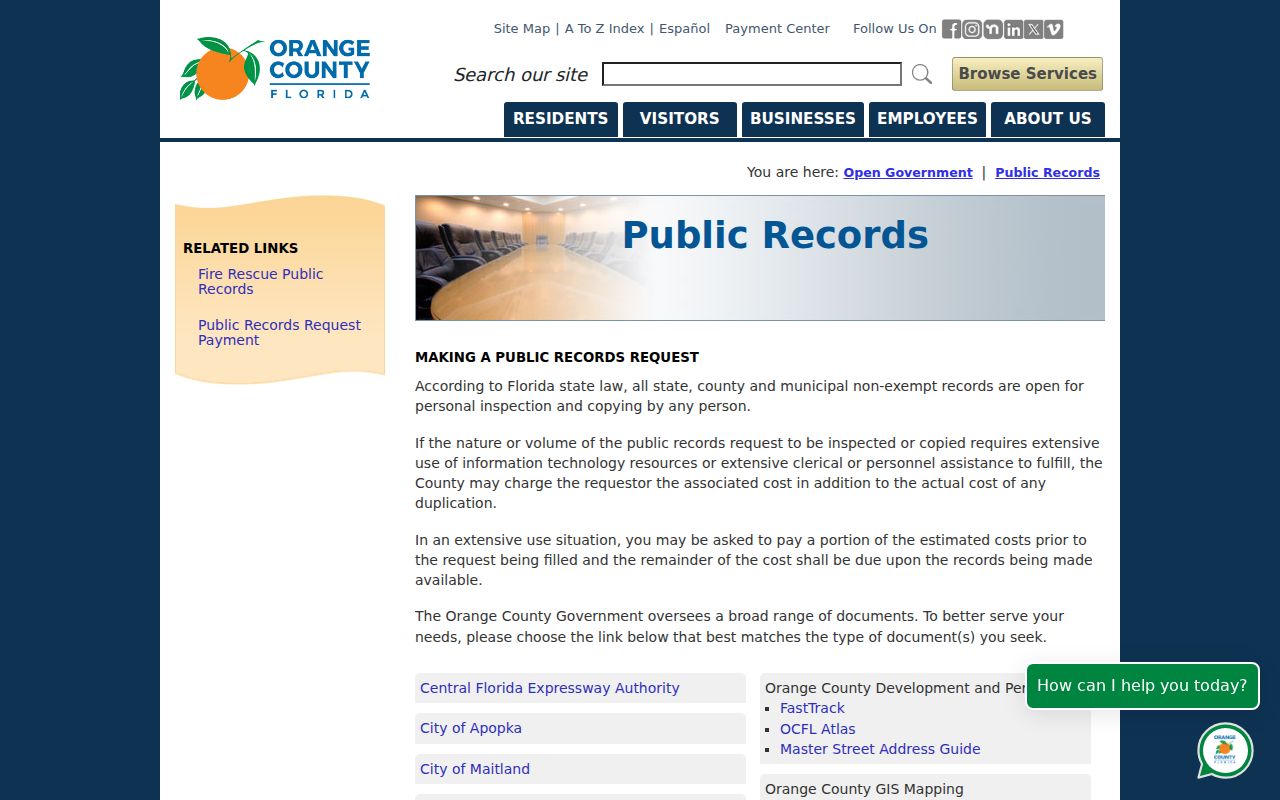
Orange County's public-records gateway helps route a request to the correct agency. Its captured page reinforces that the request starts with the custodian, not with one countywide database.
A clear request is often faster than a broad demand for all records about a person.
Terms Used in Orange County Resident Searches
Public databases use short records terms that change how a result should be read. Defining them before comparing sources helps prevent a false match.
- Roll
- An official list made for a set task, such as property assessment or voter registration.
- Index
- A finding tool that points to a document or case; it may not contain the full record.
- Parcel
- A mapped unit of land with its own identifier and legal description.
- Situs address
- The physical location of a parcel, which may differ from the owner's mailing address.
- Criss-cross directory
- A directory arranged by street or phone number instead of only by surname.
These distinctions explain why an owner, voter, court party, business officer, and directory householder cannot be treated as the same category.
Vital Certificates Have Record-Specific Limits
The Florida Department of Health in Orange County issues local birth and death certificates. The state Bureau of Vital Statistics issues statewide birth, death, marriage, and dissolution certificates. Orange County marriage service and divorce case files remain with the Clerk. Under Florida Statutes chapter 382, birth records stay confidential until more than 125 years old. Marriage and dissolution certificates are public. Death certificates without cause are public, while cause-of-death information is restricted for 50 years.
Review Florida's vital-record application library for the proper form and eligibility terms.
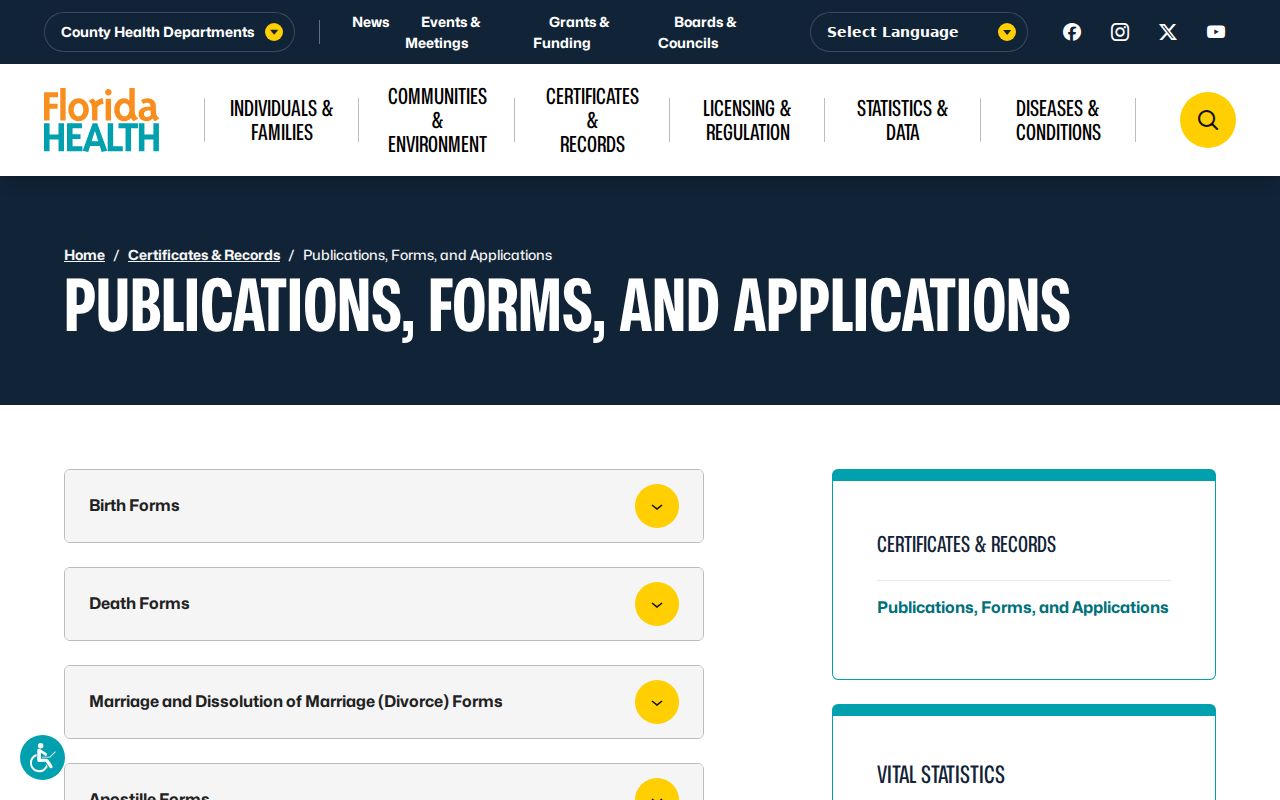
A certificate is ordered through the issuing office. Public access to one certificate type does not open restricted facts in another.
Orange County Historical Directory Shelves
For past households, the local research network includes the Orange County Library System Genealogy Collection, Orlando Public Library, Orange County Regional History Center, Orlando Memory, UCF Special Collections, Florida Memory, and the State Library and Archives. Orlando city directories include annual and intermittent volumes, with later runs commonly published by R. L. Polk. Exact shelf years must be checked volume by volume because the official public pages do not publish a complete run.
A city directory may show a name, spouse, occupation, employer, address, and abbreviations such as wid for widow or h for home. Street or criss-cross sections can reverse the search from an address to a listed householder. Pair the entry with census schedules through 1950, newspapers, deeds, tax rolls, Orlando Memory, and Sanborn maps. The full collection method belongs to the Orange County city directory shelf.
The 1937 Social Register of Orlando offers a different view. It records club and social-network details rather than serving as a complete resident roll. Such a source can add context, but its exclusions are part of the evidence.
Use Orange County Records for Lawful Personal Research
Public access supports genealogy, estate and heir work, civic review, scam checks, and reconnecting with relatives or classmates. It does not remove the need for care. Address Confidentiality Program records protect eligible victims of domestic violence and stalking under Florida Statutes sections 741.401 through 741.465. Other address exemptions appear in section 119.071 and related laws. Sealed cases, juvenile and adoption material, motor-vehicle data, and restricted vital facts also remain outside broad public access.
A missing person or address may reflect a legal protection, an exempt record, a lag in the source, or simple nonparticipation. Do not work around a safety protection. Verify public facts with the custodian and respect the limits attached to each roll.